Across the world, women are fighting for the right to free, safe, and accessible abortion. We believe that being informed about these struggles and experiences strengthens transnational feminist solidarity. With this in mind, we launched a new interview series, “Abortion Struggles Around the World”. For the third interview in the series, we spoke with abortion activist and journalist Amy Littlefield, who recently published a book titled Killers of Roe. In addition to the activities of anti-abortion movements, we also discussed the struggles of feminist groups and pro-choice organizations in the United States.
Eda: I just wanted to thank you Amy. It was amazing that you accepted our interview. So, we would like to know you a bit more for the readers as well. Can you maybe introduce yourself?
Amy: It’s really an honor to talk with both of you and to hear about your work in Turkey as well. So my name is Amy Littlefield. I am a freelance journalist based in Boston in the United States. I write about abortion rights and have covered that topic for over 10 years, mostly for a progressive magazine called The Nation. And I recently published a book, it’s called Killers of Roe, that looks at the 50-year struggle of the anti-abortion movement to kill the fundamental right to abortion, to take down Roe v. Wade, which happened here in 2022. I cover the anti-abortion movement’s operations and then I also cover how the feminist and abortion rights groups here in the U.S. are pushing back against that.
İrem: So we don’t know much about the history of the right to abortion in the U.S. How was it legalized and what is the current situation? Maybe you can briefly talk about it.
Amy: So as in much of the world, abortion was commonplace in the United States historically. Abortion remedies used to be advertised in newspapers. Often they were performed through herbal remedies or other concoctions. And there were also people who would perform abortions, like the notorious Madame Restell. And this was sort of routinely taking place until the later half of the 19th century. And at that point, the first anti-abortion movement in our modern history got started. And it was led by male doctors who were trying to professionalize and trying to run the lay midwives, who were women, out of business and to elevate their profession above these lay healers and midwives. And so the American Medical Association actually led the charge to institute abortion bans. There were also other issues at that time. There were anti-vice and anti-obscenity laws that were being championed by a postal inspector named Anthony Comstock, who was trying to get rid of things like pornographic drawings being sent through the mail, but also abortion pills and contraception.
And then there were also concerns about immigration and about falling birth rates among white women that all sort of conspired to make it so that by the early 20th century, abortion was illegal in every state. In the 1960s and early 1970s, states began to liberalize or repeal their anti-abortion laws. And that happened because women were dying. They were going to unsafe abortion providers, or they were trying to induce abortions themselves. The most famous method was the coat hanger, right? But they would use lots of different objects or household chemicals. And so hospital septic wards, especially in cities like New York, were filled with people suffering terrible consequences from uterine infections from botched abortions. And so states, including New York, began to legalize abortion, or at least allow it under certain circumstances. And then what that created was this divided system where your ability to access an abortion depended on where you lived and how much money you had.
And so for people who had money, they could travel and pay for an abortion in a place where it was safe. For people who didn’t have money or who didn’t have access to a private doctor, they would self-manage an abortion or go to an unsafe provider, and they would often die or get very sick as a result. In 1973, the Supreme Court decided to establish a constitutional right to abortion. And so the decision Roe v. Wade in 1973 eliminated all the state bans on abortion and created a nationwide right to abortion. And from there, clinics that were often run by feminists began to open to provide safe abortion care. And there was this idea that abortion would be legal and free and available.
But very quickly, the anti-abortion movement began to win incremental victories. And the first major victory came in 1976 with a policy called the Hyde Amendment. The Hyde Amendment banned federal funding of abortion, and it meant that in most states, people who were on Medicaid, which is our public insurance program, could not have their abortions paid for except under narrow circumstances.
And so when you talk about public hospitals and people getting free care in public hospitals, we do have some public hospitals here, but a lot of people get their health care in private facilities. And most, if not all, of the abortion clinics I know about are private. But in many of them, you can use your public Medicaid insurance card if you’re someone who’s low-income enough to be on state insurance. But because of the Hyde Amendment in a majority of states, that state Medicaid card is useless if you need an abortion. It just won’t pay for it. In some Democratic-led states, like where I live in Massachusetts, Medicaid does cover abortions, and that’s either because of court rulings or because of state policies.
And so really soon after Roe v. Wade, the same divisions of wealth and geography that had shaped access before 1973 still shaped it afterwards. It still depended on whether you lived close to a clinic or whether you lived in a state where your Medicaid might cover abortion, or if you had private insurance, or if you had $500 in your bank account to pay for an abortion in a clinic. And then over 50 years, what we saw was the anti-abortion movement winning small, incremental victories, often at the state level.
And we have 50 different states, so there’s a lot of state legislatures that were passing bills that would chip away. So for example, bills that said you need to wait 24 or even 72 hours between your first appointment and the abortion, which meant that if someone lived in one of the handful of states where there was only one clinic and they had to drive 100 miles to get to that clinic, they had to have their first appointment and then drive back, and then come back two or three days later and have their second appointment. And so there were all of these unnecessary obstacles that over time closed down a lot of abortion clinics, because some of these laws would say things like your hallways have to be this wide, your doorknobs have to be this shape, your procedure room needs to look like this, and clinics couldn’t do it, and so they would shut down.
And so for decades, what we had was a back and forth where these Republican-led states would pass really restrictive anti-abortion laws, abortion rights groups would oppose them, it would go into the federal courts, it would make its way up to the Supreme Court, and then we’d have a ruling that tended to allow more restrictions to come into place, although Roe v. Wade was kept intact until June 24, 2022, when the Supreme Court overturned Roe v. Wade at last. It’s been a long struggle but that’s the story in a nutshell.
Eda: So the grounds for Roe v. Wade was the 14th Amendment, right?
Amy: Yeah, it was the 14th Amendment’s right to privacy. So, critics on the right wing will talk about how the Supreme Court justices found a right that didn’t actually exist in the Constitution—that they found it in the penumbra of the Constitution and invented this right.
I think you’ll also find feminist critics who don’t think that the 14th Amendment and the right to privacy were necessarily the best avenues for ensuring abortion access, that perhaps we should have had something more centered on women’s rights and equality than on the idea of privacy, which in the Supreme Court’s decision very much had to do with the right of a male doctor and a female patient to make a private medical decision together, right? So it was very much centered on the rights of doctors rather than on women themselves.
Eda: I think that’s an important distinction who you center the decision on. Maybe we can talk about the immediate consequences of the decision to overturn Roe.
Amy: The thing to say about how Roe v. Wade was overturned is that we have a very influential conservative movement in this country that was laser focused on overturning Roe v. Wade. And so there was a group called the Federalist Society that was particularly influential, and they basically were able to select the Supreme Court justices that Donald Trump then appointed, and the justices were really chosen specifically because they were going to overturn Roe v. Wade. And so that’s why, to me, it wasn’t a shock when they did that, because they were put on the Supreme Court to specifically do that. They were vetted for their opposition to abortion. So, after the Supreme Court overturned Roe v. Wade in June 2022, what happened is that there were a number of states that had these trigger bans in place. These were bans that automatically went into effect once Roe v. Wade was no longer the law of the land. There were other states that had legislatures where they passed new abortion bans. In total, pretty quickly after Roe v. Wade, more than a dozen states banned abortion outright. And so today we have 13 states that ban abortion, except in very narrow circumstances, like if the person’s life is in danger. A lot of them make exceptions for rape or incest. And then there are an additional four states that ban abortion at about six weeks. And so it’s extremely hard to get an abortion in those states, because a lot of people don’t even know they’re pregnant until six weeks or later. A lot of the states where abortion is banned, if you look at the map of access in the United States, a lot of the South, the Southeastern United States, is completely without abortion clinics, because a lot of the conservative states in the South have shut access down completely. The saving grace for access in the United States is that after Roe v. Wade was overturned, clinicians in Democratic-led states, like where I live in Massachusetts, began to push for these so-called shield laws. And the shield laws protect doctors in states like New York and Massachusetts who choose to mail medication abortion to states like Texas and Alabama, where it’s banned. And because these doctors feel protected, as long as they don’t go to the states where abortion is banned, they are mailing medication abortion freely into those states.
As a result of these changes, and the bravery of the doctors who are participating basically in a legal experiment in real time—because we don’t know whether the Supreme Court will allow this system to continue—people who live in the South now have access. For people who know and trust these options, even though this is new, different, confusing, and scary, they can go online and order these pills and have them sent to their door, regardless of how rural they may be, or what state they may live in. And so as a result, the number of abortions in the United States has actually gone up since the Supreme Court overturned Roe v. Wade, which is shocking when you think about it, right? And I think it’s a huge testament, actually, to the strength of abortion rights activists and clinicians who got really creative in the wake of this defeat and figured out how they were going to continue providing abortions to people who needed them.
Maybe one thing that I would add is that, first, we had a sad story with the overturn of Roe v. Wade, and then a happy story because abortions are going up anyway. But then there’s also another sad story that should not be ignored, which is that women are dying in states like Texas and Georgia, where abortion is banned or heavily restricted. And they’re dying, not necessarily in the way that we expected before Roe v. Wade, where it was the coat hanger and the unsafe abortion and the back-alley provider. Now what’s happening is that women who are suffering from miscarriages or from the rare complications that can happen from medication abortion, they go to the emergency room for help and doctors are afraid to end the pregnancy and to treat them. And so they die. So the same sort of infections that people got because of back-alley providers in the years before Roe, are now happening in places where abortion is illegal and where doctors are afraid they’re going to go to jail if they end someone’s pregnancy, even if they have a fever or they’re sick. And so as a result, we’ve seen numerous cases where women have died because they haven’t gotten treatment either for a miscarriage or for an abortion complication in states where doctors are afraid they’re going to be accused of performing a felony and go to jail.
Eda: That’s important. So that’s a possibility for a doctor to be accused of providing abortion, even though the woman is having a miscarriage.
Amy: Well, and I think there is an important difference between what the law actually says and then how doctors react in the moment and their fears about the law. In some states, like Texas, where you can go to jail for 99 years for performing an abortion, if the woman miscarries, but the fetus still has a heartbeat, then the doctors might wait until the fetus doesn’t have a heartbeat or until they know that the woman is sick enough that they can actually intervene. And so we’ve seen cases where they do finally intervene, but it’s not soon enough.
There was also the case of a woman named Tierra Walker in Texas. She wanted an abortion because her pregnancy was making her sick, and she was at risk of developing preeclampsia, which is a really serious pregnancy complication. But she couldn’t get an abortion because it wasn’t considered enough of an emergency to meet the threshold in the law. And she died. Preeclampsia killed her and her son found her dead on his birthday. These are the sorts of tragic stories that we’re seeing as a result of abortion being banned. Even though medication abortion is widely available and a lot fewer people are being forced to carry pregnancies to term than we expected.
There was a significant case in Ireland, Savita Halapanavar, who died in a hospital and was told that Ireland is a Catholic country and therefore she couldn’t have treatment for her miscarriage. And as a result of that, Irish activists repealed the Eighth Amendment. They were organized and ready to move. And so I think here we’ve seen multiple women die, and it does make the news and Democratic politicians talk about it. And yet, it hasn’t been enough to change the law, which is one of the questions that I find so devastating. Like, why isn’t one person’s death, when we know about it, when we can connect it to one of these anti-abortion policies, why isn’t one dead woman enough that we can change these laws?
Eda: I’m also curious about this, you mentioned that the number of abortions have gone up, and it’s been steadily going up for a while, and how do the anti-abortion movements react to that? They must know.
Amy: They know, and they are very angry about it. And what’s even more infuriating to them is that they have a Republican president, the same president who put the Supreme Court justices in place who overturned Roe v. Wade. They are frustrated with him because he could have issued restrictions on the mailing of abortion pills on day one. He could have revived the 1873 Comstock Act, the law named for Anthony Comstock that we talked about, to try to stop the shipment of abortion pills.
And so they’re very frustrated that they achieved this huge legal victory. And yet, in practice, the number of abortions has gone up, and so their goal has not been met.
In early May, there was a three-day period where the lower court stopped the mailing of mifepristone, and a lot of the telemedicine services began shipping just misoprostol only. And so they were ready with a backup plan. The other thing that we have a lot of that nobody is really keeping full track of are community support networks. So activists who are mailing medication abortion, or dropping it off at someone’s house, or meeting someone in a park somewhere and giving it to them. And that is happening on a huge scale. And nobody is getting an accurate count of that. Because when I’ve talked with these activists, they’re like, I’ve personally provided thousands of abortions by sending these pills through the mail. And I haven’t reported those numbers to anyone. And so there are swaths of the abortion access landscape here, where the US legal system really can’t intervene in a meaningful way, because they’re not going to be able to arrest everybody who has access to a mailbox.
İrem: And these communities, do they consist of women’s and feminist organizations? Is it a kind of feminist accompaniment model, or something more than that?
Amy: So it’s like accompaniment. Here, often the people who do this work will call themselves abortion doulas. And it tends to not be formal feminist NGOs that are doing the work. People can’t talk about it openly. And so these are specific organizations that have been set up to do pill circulation in a way that doesn’t put anyone’s nonprofit status or public persona into jeopardy. Abortion doulas are people who will text with somebody in the middle of the night, who’s having an abortion and tell them, this amount of bleeding is normal, this amount isn’t, this is when you need to seek help. So there’s a lot of person-to-person support that’s developed here, all of which is relatively new, there was some amount of it before 2022 but a lot of it has developed after. And a lot of it has been learned from organizations in Latin America, like Las Libres, that were used to providing abortion person to person and supporting people through the accompaniment model in a context where abortion was criminalized. US feminists had been very used to abortion being legal, and all of a sudden it wasn’t. And so there was a lot to learn from our Latin American neighbors about what that could look like.
İrem: They are very good neighbors. Very experienced, the best neighbors that you have.
Amy: I’m not sure we’ve been good neighbors to them at all, but they have been, at least the feminists have been very good neighbors to their peers in the US.
İrem: Maybe we can elaborate on this. You said it’s relatively new, and it’s really a different relationship with accessing abortion. Do you see any change in the way women think about having abortion in that kind of situation?
Amy: Yeah, absolutely. It has been difficult, I think, for a lot of people who are used to thinking of abortion as something that you go to the clinic to get, to trust some of the new outside the medical system methods that are now available. These are medication abortions that are being provided by licensed clinicians who message with their patients online, but don’t examine them in person. And because these methods are cheap, or even free, and people are used to paying a lot of money for healthcare services in the US. I’ve talked to people who have accessed these methods, and often their first thought is: this must be a scam. This is too good to be true. How can it be so easy? And when they don’t have to go in person and have an exam, or maybe wait 24 hours, or go through all of the hoops that you used to have to go through, they think there’s got to be some kind of catch. And so a lot of people have trouble trusting these options, and they’re afraid that they’re being scammed. I think that has been a huge learning curve, but we’re starting to see people beginning to trust and understand these methods more, because they’ve been around now for a few years.
İrem: And it’s apparently very common, right? We read that 70% of the abortions in the US are now medical abortion.
Amy: More than two thirds of abortions in the US are medication abortion, and about one in four abortions is done via telehealth so no in-person appointment. That’s pretty astounding.
Eda: At the beginning, you said you have been reporting for more than a decade now, you have been reporting on abortion rights. How did you end up there? I mean, it’s a very niche topic for a journalist.
Amy: It is, yeah. And 10 years ago, there were not very many people reporting on this because it was considered a very niche topic. And I started out volunteering as a clinic escort when I was in college. So I would walk with, I don’t know if it’s the same in Turkey, but every clinic in the US has protesters outside. So there are anti-abortion protesters who will show up on the sidewalk, and they’ll try to talk to women and they’ll hand out pamphlets and get right in their face. And so I would volunteer walking with women from the parking lot into the clinic to try to shield them from the protesters. And then I worked in a clinic as a counselor for a few years after I graduated from college. And I always wanted to be a journalist. And so at some point I found a way to bring the two of those things together. And when I was first covering it, it was clear the direction we were heading in, that we were heading towards the reversal of Roe v. Wade through these incremental restrictions. And it was this slow-moving emergency that we were all trying to sound the alarm about. And I think a lot of people didn’t believe that Roe v. Wade would be overturned. A lot of people trusted the courts and trusted the government a little too much. And so now here we are. At least in the last election, it was considered a big political topic. Now what I hear from people again is, oh, abortion, I haven’t heard so much about that lately. Well, there’s a lot of other things going on in US politics.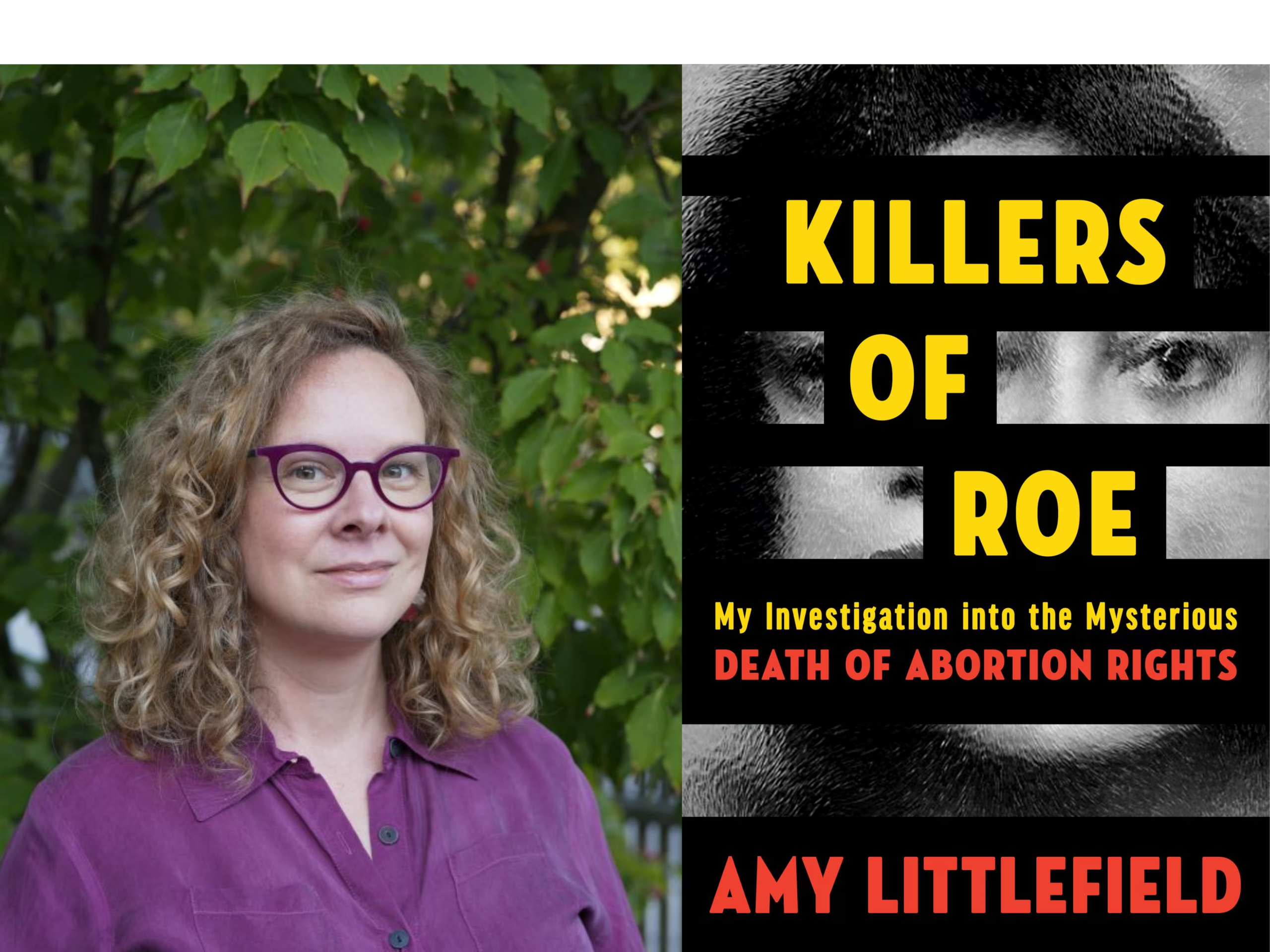
Eda: We talked about abortion a lot, but we can talk about the state of reproductive rights in general in the US, because it comes with a package, especially when it comes to anti-abortion movements. Anti-abortion movements are at the same time almost already anti-gender movements. They are very misogynistic, they are against equality etc. And it probably boils down to reproductive rights as well. Is there any specific political movement around reproductive rights – right-wing movement, I’m asking?
Amy: Yeah, I’m so glad you asked that. One piece that I think is important to highlight is the dark history of policies to force the sterilization of women of color and of people with disabilities. There’s a long history in the United States of states passing laws that allowed people who are incarcerated or disabled or mentally ill to be sterilized against their will.
The Supreme Court validated those laws in 1927. And we saw the idea that taxpayers have to pay for children who are born into families where they’re on welfare being used to justify sterilizing tens of thousands of people who were often Black women in the South, or people of color, or folks who were living in institutions, either prisons or mental health institutions. And so those policies and practices that restricted reproductive rights in the other direction, but that were very much related, is another really important part of U.S. history to highlight. And that’s why Black women in the U.S. developed this framework called reproductive justice that’s about the right to have an abortion, but also the right to have children if you want to have children, and the right to raise those children in safe communities. And so all three of those things are important.
The other thing I want to highlight more recently is the way that the very same playbook that was used to dismantle abortion rights in the United States is now being used to target transgender people. And so what we’ve seen is the same Christian right organizations that successfully took down abortion rights are now rewriting their policies to go after young people who are transgender, to go after the idea that trans people should be able to play sports. And in the same way that abortion restrictions first targeted young people, women of color, people on public insurance, we’re now seeing those same incremental restrictions targeting especially young transgender people in this country. And what’s so infuriating to me sometimes is that people don’t see the connections.
It’s like, this is literally a copy paste. One of the first restrictions on abortion access in this country was that young people in many states couldn’t get one without a parent’s permission. Well, now they’re going after young people and their ability to access gender affirming care, even in blue states. Some of these restrictions are federal so they’re affecting people even in blue states like Massachusetts where I live. And so those things are very much intertwined and need to be confronted together.
İrem: Many people face barriers to abortion due to geography, race, or class. Do you think medical abortion provides an opportunity to overcome these challenges and increase access, even if not for everyone?
Amy: Yeah, one of the really interesting perspectives I heard from one of the doctors I spoke to who runs a service mailing medication abortion into states where it’s banned, she was telling me that she’s anecdotally seen an increase in women who seem to come from really conservative, Christian, evangelical, rural areas, who have a lot of children, and who are now able to access abortion for the first time. Because for them, if they live in a conservative religious community, if maybe their husband or their family doesn’t approve of abortion, then they’ve just had children every time they’ve gotten pregnant. There hasn’t been another option. And now they’re able to go online surreptitiously, get the pills sent to their door and take them without anyone ever knowing.
And so they don’t have to drive many hours to a clinic. And so in some ways, these adaptations that came about because of the restrictions on abortion, have actually opened up access to parts of the country where it wasn’t available before, and to people who couldn’t get it before. Abortion, for most people in most states in this country, used to cost hundreds of dollars, because you had to go to a private clinic and pay. And if it was later in pregnancy, it could be thousands of dollars. You had to pay out of pocket and because of the Hyde Amendment, there were strict restrictions on public funding.
And so the fact that it now can be sent through the mail for $5, or for free, because it’s very cheap to provide medical care that way and a lot of these groups have gotten philanthropic support for their work, means that it’s more available to some people For example, in Mississippi, there used to be one abortion clinic. And if you lived in Mississippi, you’d have to drive hours to that one abortion clinic. Now you can get a package sent to your house for free. In some ways, it’s easier. That being said, somebody, if they want a clinic abortion, or they’re later in pregnancy, and it’s better for them to be in a clinic, they may not necessarily be able to do that. And so their options are limited. But in some ways, their access has expanded. So, it’s really interesting.
Eda: As much as there’s anti-abortion movement, there’s also pro-choice movement and feminist movement going on. And the U.S. is a huge country with very fragmented movements, I believe. But can you give us at least a broader picture of how the abortion struggle is organized?
Amy: The biggest thing to know, we have a few really big reproductive health care organizations, the biggest of which is Planned Parenthood. And Planned Parenthood provides health care to millions of people. They run abortion clinics. And in those clinics, they also provide birth control and STD testing and gender affirming care for trans people. So they are really important safety net health care providers, especially for low-income Americans. And they rely on federal funding in order to keep that work going, not for the abortion services, but for contraception and other health care services they provide, they receive support from the federal government—although recently Republicans cut that support. And so I think that has always meant that Planned Parenthood is more conservative, more careful, more inclined to keep relationships with Democratic politicians because they want to protect their federal funding, which makes sense. A lot of patients rely on it. But I think, in retrospect, one of the mistakes that the abortion rights movement has made is to allow an organization that is reliant on federal funding to determine policy decisions and political direction. Because they just have a more limited or a more cautious approach. I think since the Dobbs decision, that has started to shift a little bit. So groups that are based in red states, groups that are led by women of color, groups that are closer to the people most impacted by abortion bans, I think have always existed and just have gotten fewer resources and attention. And I think that has started to shift a little bit. The shield laws came from a group of academics and clinicians who were sort of outside of the institutions like Planned Parenthood. So, I think this is sort of a moment for more creative grassroots ideas and approaches that aren’t so much coming from the same institutions that have tended to lead the movement.
And I think the part of the abortion rights movement that I think is most worth highlighting here, and that’s pretty impressive in my view, are the abortion funds. So for the past 50 years, the Hyde Amendment has banned federal funding of abortion. People often have to pay hundreds of dollars if they need one. And we have dozens of small grassroots organizations that exist just to raise the money that people need for an abortion and to pay some of them for the travel costs, if they need a hotel or a bus or a plane ticket, and then to pay for the abortion itself. Those organizations combined spent more than $50 million in 2024 alone, right? $50 million in one year. And that still was not enough to meet everybody’s needs. They still had to turn people away and weren’t able to help everybody.
But that to me is still an amazing number that this grassroots feminist abortion fund infrastructure was able to raise and spend that amount of money with this sort of crowdfunding approach to abortion care that we have. And I think there has been in recent years more of a recognition of the people who are doing that work, which is often kind of behind the scenes and not super glamorous, and they’re not always the ones out front talking to the TV cameras, but that work is very important and has mitigated the impact of a lot of these abortion restrictions.