Across the world, women are fighting for the right to free, safe, and accessible abortion. We believe that being informed about these struggles and experiences strengthens transnational feminist solidarity. With this in mind, we are launching a new interview series, “Abortion Struggles Around the World”. In this first interview of the series, we conversed with Daniela Andreassi of the Socorristas en Red network, a feminist collective that has long been at the forefront of the struggle for abortion rights in Argentina. We talked about the movement that finally won the legalization of abortion, the transformative impact of the Green Wave, the barriers in accessing abortion under the current political context, and the feminist practice of abortion accompaniment that Socorristas has developed and maintained over the years.
Thanks to years of feminist struggle, Argentina became one of the few countries in Latin America to legalize abortion in 2020. Can you tell us about this process? Has your struggle changed its political stance or political message over the years?
The law 27,610 of Voluntary Interruption of Pregnancy is the law most collectively fought for. We affirm this because we feminists understand the importance of tracing genealogies and the legitimizing power of collective constructions that emerge from the grassroots and thrive thanks to persistence, militant conviction, and presence in the streets.
The demands for access to abortion in Argentina dates to the 1960s and 1970s, when feminist struggles were intertwined with other social movements. During the International Women’s Year in 1975, demands for abortion rights were raised. In the 1980s, with the restoration of democracy, the first explicitly feminist discussions and struggles emerged. In 1984, the first march for International Women’s Day was held in Plaza Congreso with slogans such as “Decriminalize abortion now.” In the 1990s, the first bills on contraception and abortion were introduced.
For decades, the demand for legal abortion grew and gained strength and visibility, gradually encompassing more and more political, social, and activist sectors, aiming to put abortion on the public agenda as a matter of health and public policy, but also of autonomy, agency, and desire.
In 2005, the National Campaign for the Right to Legal, Safe, and Free Abortion was created. Its motto was “Sex Education to decide, Contraceptives to not abort, and Legal Abortion to not die”. The Campaign coordinated activists, organizations, and political parties nationwide, all dedicated to advocating for the social legitimation of abortion, drafting a bill, and systematically lobbying the National Congress to gain support and ensure the issue was included on the legislative agenda.
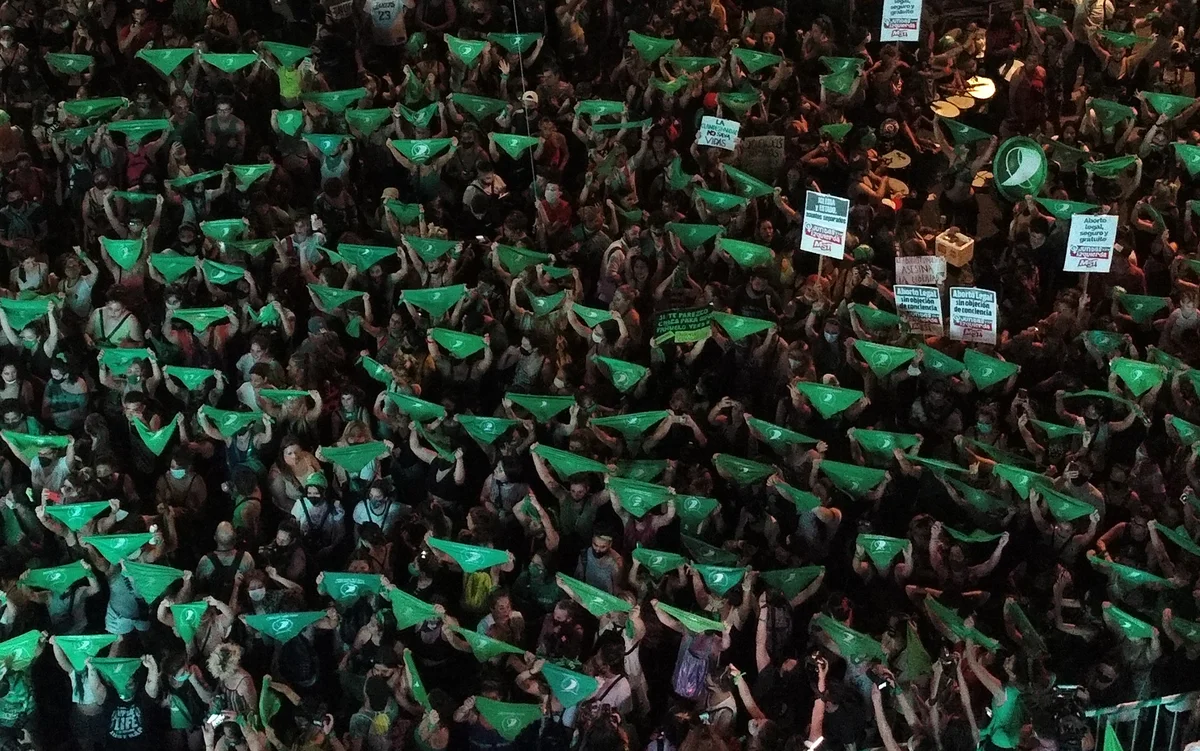
Its symbol, the green scarf, was invented in 2023 in reference to the white scarf the Madres and Abuelas of Plaza de Mayo wore during the dictatorship years to claim for the appearance of their children and grandchildren. To this day, seeing someone wearing the green scarf is a sign of solidarity. It is like saying “we are fighting for the same thing.” It is a symbol of identity that has crossed borders and expanded worldwide.
In 2018, the Voluntary Interruption of Pregnancy bill was discussed in Congress for the first time. Although the bill obtained preliminary approval in the Chamber of Deputies, it did not pass. That preliminary approval was accompanied by a vigil of over a million people across the country, who took to the streets and celebrated the partial victory.
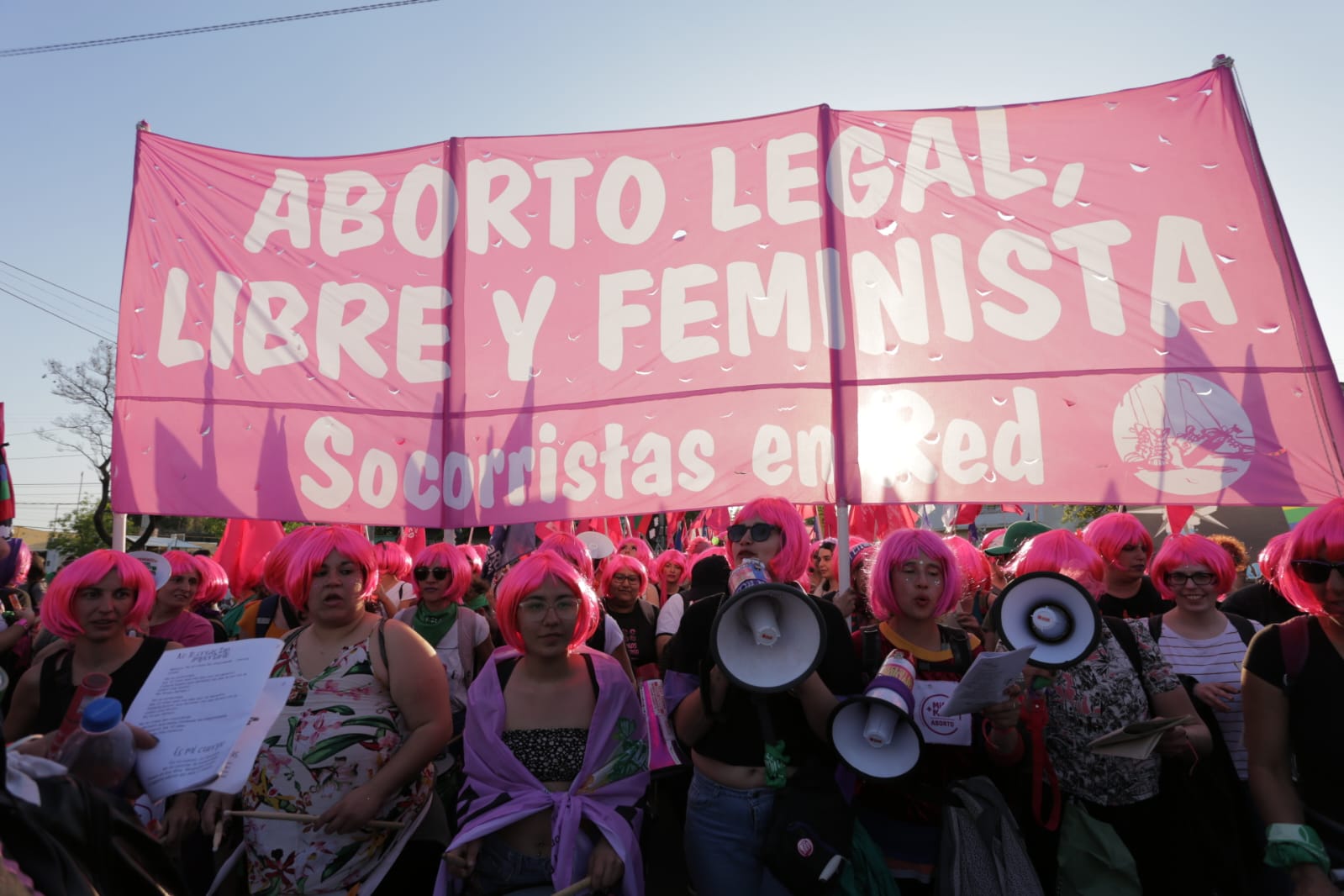
In August of that year, amid another massive mobilization, the Senate rejected the bill. However, popular mobilization had already become massive and unstoppable, driven by the overwhelming force of the so-called Green Tide. This mass movement had several distinctive characteristics. One was its transversality, cutting across many sectors (unions, political parties, activist groups, social movements, human rights organizations, etc.) and bringing them together behind a common demand. Another, and the one that gave it much of its momentum, was its intergenerational character. A new generation of young people, awakened to the feminist struggle with the arrival of the Ni Una Menos movement against gender violence in 2015, found in the demand for the legalization and decriminalization of abortion the call that led them to take to the streets with incomparable vitality. This is why the Green Tide is also called “the revolution of the daughters,” alluding to the rich legacy of Argentinian women-led activism by the Mothers and Grandmothers of Plaza de Mayo.
The certainty that this battle had to be won in the streets led to mobilizations throughout the country. The debate was omnipresent and enriched by every activist who took part. Many topics were discussed: the tension between legalization and/or decriminalization; the inclusion of pregnant people who do not identify as women; the understanding that abortion was a debt owed by the State; among others.
The most distinctive action during those effervescent years leading up to the law were the pañuelazos: protests that involved raising the green scarf as a battle flag, held weekly in many cities across the country.
Due to the coronavirus pandemic, the massive in-person marches that had characterized the abortion rights movement had to be re-created online through social media campaigns. Yet they did not weaken.
In 2020, the bill was discussed again in Congress, accompanied by hundreds of vigils occupying streets and squares throughout the country. In the early hours of December 30, the law was passed, and the popular celebration was immense. Intergenerational and plural feminism made it possible.
Can you explain the current situation regarding abortion? How does it work in practice? For example, although abortion is legal in Turkey, there is a de facto ban on women’s access. Do you experience similar problems? How do Milei’s anti-abortion statements affect access?
The law is there, but obstacles remain. Milei’s government hasn’t repealed it, but they have found another way to boycott it, which is defunding it. Since December 2023, there has been no national purchase of abortion pills. Since the moment the law was promulgated, we, Socorristas en Red, monitor its implementation and denounce malpractices. Our findings point at mistreatment and stigmatization; wrong instructions of use of the medication; delays meant to discourage abortion; lack of training in universities and residencies; refusal to provide abortions; medication shortages; barriers like travel costs, childcare, or absence from work; and still, little sexual education and limited contraceptives.
In terms of quality, access to mifepristone is still not fully guaranteed and often times people received 12 misoprostol pills instead of the combi-pack. Manual Vacuum Aspiration exists but is underused. Curettage, discouraged by the WHO, is still routine.
Could you tell us a little about how you organized for the abortion struggle? Can you tell us about Socarristas en Red? What kind of work do you do, and what kind of organizing model do you have?
Socorristas en Red is a network of over 40 feminist groups across Argentina, that emerged in 2012 within the National Campaign for the Right to Legal, Safe, and Free Abortion.
We fight for autonomous, destigmatized and de-medicalized abortions, accompanying people’s decisions and their abortion journey, these being mainly self-managed with medication. Our activism is framed in a feminist ethic of care.
As part of our political commitment, we seek and generate liaisons with healthcare professionals and advocate for the enactment and compliance with Law 27,610. We hold face-to-face meetings with the people who come to us and accompany them whether they decide to self-manage their abortions or decide to go to the health system.
When we accompany abortions, we are choosing the life we want to live.
How do you contact women who want to have abortion, how do they reach you? What sort of feedback do you receive from women?
We don’t contact women or pregnant people; they reach out to us.
Each accompaniment we do is developed in four moments. First, the person calls to one of our public lines (each group has a public line in their city). Second, we hold group meetings (mostly face-to-face, but virtual if distance requires it). Third, we accompany the abortion process, mostly by phone, but eventually in person. Finally, we provide post-abortion accompaniment.
Throughout this process, we collect data that we systematize annually, building a powerful body of statistics (unprecedented in the country) regarding abortion practices and accompaniment.
In our almost 14 years of activism, we have built a deep knowledge about abortion with medication, based in attentive listening, studying and careful gathering and systematization of data. We exchange and articulate permanently with health professionals. We also conduct lectures on abortion in different universities across the country and facilitate training on abortion for health effectors. Since 2021, we are part of the Advisory Council of the National Program of Sexual Health and Reproductive Rights.
In each accompaniment that we do, we make it clear that since the enactment of Law 27,610 every person has options. They can choose if they want to request their abortion in the health system, or if they wish to self-manage their abortion. They can choose if they want to abort with pills at their home or with a manual vacuum aspiration at a medical facility.
In accordance with de-medicalizing sensitivities that dispute the hegemony of the Health System over autonomous practices of people, we affirm that the abortion belongs to the person who aborts.
During these years, we have deepened the links with the health system to insist that other abortions are possible. These joints are part of complex and very dynamic constructions that sometimes bring us closer, and many others, differentiate us. The latter becomes more palpable from the enormous political, social and cultural change that Law 27,610 entails.
Recently, matters concerning children’s sexuality, sexual orientation, and gender identity have become increasingly controversial around the world, especially in discussions about transgender children. We haven’t heard as much discussion on issues such as teenage pregnancy and children’s access to abortion services. How have discussions progressed in your country regarding teenagers’ access to abortion? For instance, in Turkey, abortion for minors (people under 18) requires parental consent. Moreover, legally it falls under the purview of criminal law; therefore, even though pregnancy is a result of consensual relationship, the case is almost automatically referred to the prosecutor’s office. You mentioned laws that allow minors to terminate pregnancies without third-party consent. Could you give us more information on these discussions? What is the current law and practice in terminating adolescent and child pregnancies? What work have you done regarding parental consent?
Argentine law considers anyone over 16 years of age to be an adult and autonomous in making decisions regarding their health and bodily autonomy. No assistance from another person is required to access the right to an abortion.
Individuals aged 16 and over can sign or give informed consent and sign the required sworn statement in cases of rape. As for the individuals between 13 and 15 years of age, if the procedure does not pose a serious risk to their life or health, they can give their consent autonomously. If the procedure involves a serious risk to their life or health, the law requires their consent, plus the assistance of a trusted adult*. For individuals under 13 years of age, they must give their consent with the assistance of a trusted adult*.
(*)Trusted adult: it can be their mother, father, legal guardian, or other people who care for them and whom they trust.
Can you tell us more about your experience on medical abortion? How did it start in Argentina? Is it widespread? How effective is it? And what kind of feedback do you get from women?
Medication abortion appeared in Argentina in the late 1990’s, when the finding of the Brazilian women that the misoprostol could effectively provoke miscarriages, spread throughout the region. It is the most widely used method for the voluntary and legal termination of pregnancy in Argentina, as the law provides for its implementation.
The extremely high effectiveness and safety of medication abortions (98-99% for mifepristone and misoprostol, and over 90% for misoprostol alone) has been extensively proven and studied over the last few decades, to the point that it is the method recommended by the World Health Organization in its 2022 guidelines. We feminist activists have long known how incredibly safe and effective abortion pills are, and how important it is that people have adequate information to use them correctly.
Medication abortion is often chosen by women and pregnant people despite the legal status of abortion in their countries, because of how safe it is and also because it allows them to do the abortion in the privacy of their home, whenever they want and accompanied by whomever they want (or alone, if that’s their preference).
Abortion struggles by women and feminists all around the world happen in many places where anti-gender policies, the far right, and right-wing populism are on the rise. For example, Hungary, the US, Argentina, and Poland. How do you see the significance of the abortion struggle in feminist politics and, more broadly, in national/regional/global politics?
I think that the struggle for abortion rights has become a key battleground in feminist politics, particularly in a global context marked by the rise of far-right movements, anti-gender policies, and authoritarian populism. The attacks on reproductive autonomy are not isolated events happening here and there: they are part of a broader political agenda that seeks to regulate bodies, reinforce traditional gender roles, and limit democratic participation.
Not long ago, I visited Hungary and Poland and talked with local activists. Recently I’ve been in Colombia, participating in 2 major abortion and SHRR conferences (CLACAI and ICFP), where I had the chance to talk with people from many places. Unsurprisingly, whether the abortion is legal or not, the right-wing strategies are very much alike everywhere. They all play by the same book. Of course, there are nuances, but the similarities are striking.
Within feminist politics, the fight for destigmatized, decriminalized, demedicalized and accessible abortion is a fundamental space of contestation around autonomy and the right to decide over one’s own body. It synthesizes long-standing feminist demands for sexual and reproductive justice, and it can mobilize people across different generations, identities, and political traditions.
Broad-based movements for abortion rights, like those in Latin America, have demonstrated a strong capacity to build coalitions, occupy public space, and challenge authoritarian tendencies through mass mobilization.
At a global level, the struggle for abortion access reveals how interconnected feminist movements are, and how strategies, symbols, and forms of resistance circulate transnationally. In many countries, it has become a central axis of feminist politics, as well as an indicator of the broader political landscape.
As feminists in Latin America, you work together under the umbrella of CLACAI (The Latin American Consortium Against Unsafe Abortion). Can you tell us about CLACAI and what you have learned from the experience of working together in countries with different laws and practices?
CLACAI is a regional network that brings together health professionals, lawyers, researchers and, in the past years, also activists and feminist organizations across Latin America. It was created to reduce the harms of unsafe abortion and advance reproductive justice. It works as a collaborative space to share knowledge, strategies, and tools adapted to very different legal and social contexts.
Working together has taught us that, regardless of the law or the singularities of each context, people will seek abortions. And that inequality and risk increase where access is restricted. It has also shown us that many of the challenges we face are similar across the region, which allows us to learn from one another and adapt effective strategies.
In a similar sense, Socorristas en Red is part of the Red Compañera, a coalition of feminist and lesbofeminist organizations, collectives, and accompaniment groups that support women, girls, and other people with the capacity to gestate through safe, caring, and violence-free abortion. It was created in 2017, and it gathers 21 activist networks from 15 countries across the continent.
Working within Red Compañera has shown us that regional solidarity is a powerful force: the network functions not only as a collective structure but as a space of mutual support, shared strategies, and trust. Bringing together groups from countries with very different legal, social, and political contexts has taught us to adapt our feminist, non-bureaucratic accompaniment practices while also contributing to local debates on decriminalization and legalization. Through this collaboration, we also produce and circulate our own knowledge, challenging dominant medical narratives and building evidence grounded in lived experience. Above all, our work is deeply political: accompaniment is an act of care rooted in social, sexual, and reproductive justice, and our shared goal is to achieve full decriminalization: abortion that is free, unconditional, and safe from persecution for both those who choose it and those who accompany it. In this sense, Red Compañera demonstrates that feminist abortion activism is strongest when it is collaborative, rooted in solidarity, and committed to transforming both individual experiences and broader political structures across the region.
These spaces reinforce the power of regional solidarity. Countries move forward and backward at different times, but the networks provide continuity, political support, and a shared sense of purpose in the struggle for abortion access.