We don’t think of our strategy as “revolution or nothing”, but also look at how we can improve the immediate conditions of existence for oppressed people in the here and now.
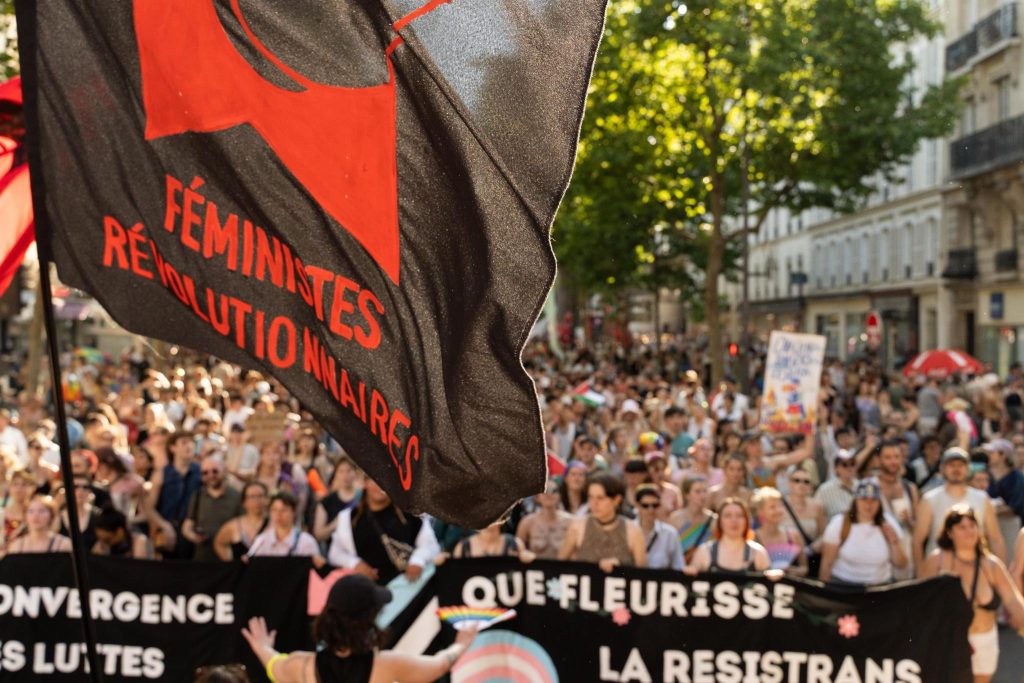
At a time when governments on the right are gaining power in many countries and making the lives of women and queer people a major political battleground, how can feminist struggles speak to one another? Can learning about experiences of organising in different parts of the world help us learn from one another while recognising both the problems we share and the conditions specific to each struggle? To explore these questions, we spoke with Féministes révolutionnaires* (Revolutionary Feminists) about their experience of organising in France.
The collective was founded in September 2016, towards the end of the struggle against the Labour Law introduced by the government led by Hollande and Valls. The Revolutionary Feminists see gender oppression as inseparable from capitalism, racism, class domination, colonialism and ecological destruction. They are involved in a wide range of struggles, from organising the 8 March feminist strike and building solidarity with decolonial struggles to campaigning against incarceration and for reproductive justice. We spoke with them about what revolutionary feminism means to them, their organising practices within the collective, and the kinds of connections that might be built among feminist struggles across different geographies.
Your collective is called Féministes révolutionnaires. Why is it important to explicitly embrace the label “revolutionary” in France? What distinguishes your collective from other feminist organizations?
Describing ourselves as revolutionaries alludes both to our analysis and to our strategy: it means that we are aware that several systems of oppression are at work together (capitalism, racism, sexism, amongst others), and that we have to change the whole system in order for all people to be free of all oppression. All of this distinguishes us clearly from many other feminist organizations or political movements in France today that are more reformist in their strategy or less intersectional in their analysis.
It also means that we identify with Marxist feminism. “Revolutionary” is a historical term, so we put it in our name to represent the fact that we actively study the history of feminism— in order to understand where we come from, to identify what we can learn from the past, and to think specifically for the present moment.
Under what political and social conditions are you carrying out feminist struggle in France today? How have these conditions changed in recent years?
Right now, the main issue of the current French political sequence is the rise of the far-right and reactionary forces. They have gained ground rapidly in the most recent municipal and legislative elections, and they are being banalized by mainstream media, and the political right and center. As feminists, we’ve seen this specifically in the appearance of femonationalist[1] groups at our demonstrations. This has forced us to elaborate and enforce a solid self defense strategy to keep them from showing up at our events. In collaboration with comrades from other queer/feminist/antifascist collectives, we’ve been successful in keeping them out. Other current issues specific to France are Macron’s government’s unrelenting and increasing attacks on our social infrastructure (retirement, unemployment, health, education, culture, agriculture to name a few…); its criminalization of immigrants; its police violence; and its repression of activist groups (for example, antifascists or pro-Palestinians). Our collective is ten years old, and we’ve seen the social movement be criminalized and broken since then, but we’ve also seen historical turnouts for mobilisations, victorious strikes, and French society calling for change. Many are having a hard time believing in traditional forms of mobilization right now: striking, blockages, and protests. We seem to be at a particular turning point where a lot of strategic questions are being asked at the same time that the political climate is forcing immediate reaction. It’s a demanding atmosphere for activism, and to be honest, it requires creativity and courage. Thankfully, in our collective we are numerous, well-organized and determined.
How do you assess the relationship between the broader left and the feminist movement in France? Which organisations, trade unions, and political movements do you most often collaborate with?
We think that one of our roles as revolutionaries is to try and spread our ideas amongst the broader left and in more reformist feminist groups (when it seems possible), to make the revolution desirable to our political neighbors. For instance, we collaborate in organizing March 8th and November 25th demonstrations with groups that are more moderate than we are, and we’ve seen progress in them moving closer to us ideologically.
We don’t think of our strategy as “revolution or nothing”, but also look at how we can improve the immediate conditions of existence for oppressed people in the here and now.
We collaborate with feminist organisations that are closest to our ideology (anticapitalist, antiracist, LGBT, pro-sex workers rights, etc.) through a network called the Coordination Féministe, which reunites about thirty collectives all throughout France. The Coordination meets regularly on weekends throughout the year, rotating amongst different locations, and holds a conference every summer. It’s a precious resource in aligning feminist forces on a national level, allowing us to join forces both materially and strategically. Otherwise, in Paris and its suburbs, we collaborate regularly with several dozens of groups, depending on the issue and the occasion. We have links with LGBT groups, antifascist groups, pro-Palestinian groups, Iranian and Syrian groups, antimilitarist coalitions, groups for the rights of migrants, as well as the principal far-left trade unions. Most of our members are union members, and so there is a lot of natural crossover there.
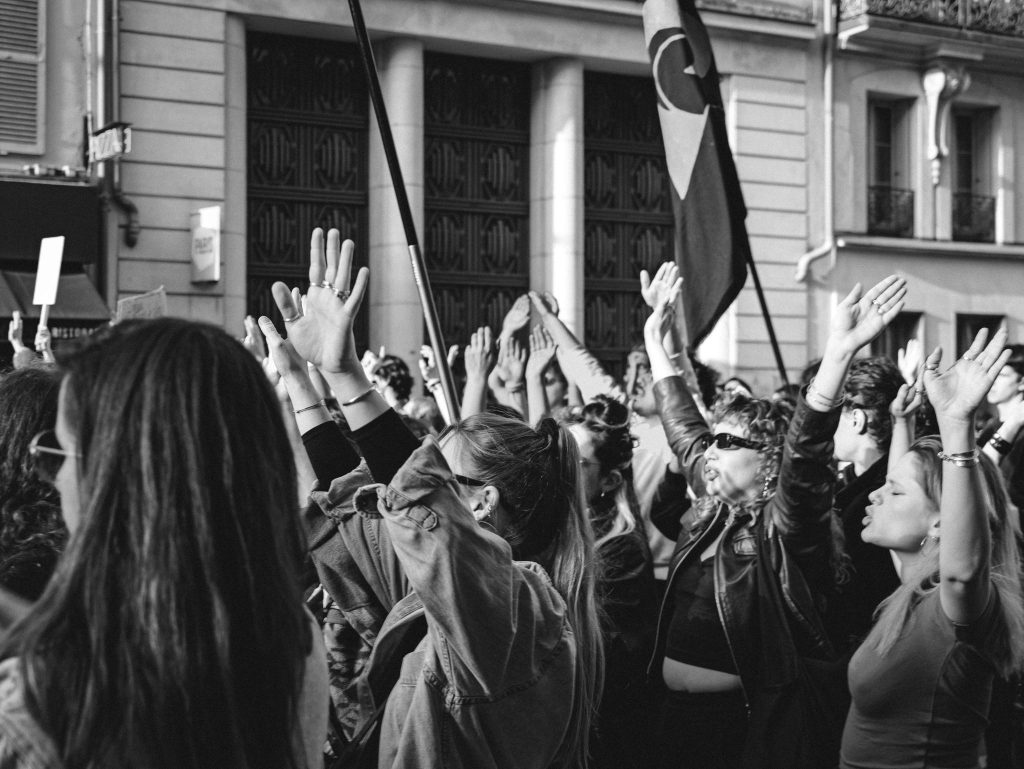
In your manifesto, you state that “the feminist strike can create a balance of power capable of weakening the patriarchal and capitalist system.” In your experience, in which sectors or among which social groups has this strategy found its strongest resonance? What do you see as the most significant achievements of the feminist strike strategy so far, and what have been its main limitations?
The strongest resonance we’ve seen of the feminist strike strategy has been among workers in the care sector, since it’s an area where a vast majority of workers are women (or gender minorities). For instance, our collective has supported successful feminist strikes led by hotel cleaning technicians, hairdressers, workers in eldercare, and recently a joint strike led by aid workers and the homeless. What’s more, the majority of the workers on strike in each of these examples are women of colour and/or immigrant workers, who are groups that are the most exploited in a capitalist society. It is very telling that the strategy they turn to is the feminist strike: while being the most exploited, they are also the most indispensable. One of our slogans is, “When we stop, the world stops.” These strikes have been long, arduous, and very often, in the end, victorious. This is exactly why we are so convinced that the feminist strike is a strategy capable of paralyzing the patriarchal capitalistic apparatus. But what is challenging with the strategy of the feminist strike has been popularizing it to the greater public, and convincing the mainstream feminist movement of its importance, as it tends to prefer social analysis to concrete, offensive action.
Striking as a strategy in general is very challenged in France these days, because Macron’s government has blatantly disrespected so many important social movements. Also, in recent years, the feminist movement in Paris has had to put most of its energy into defending itself against far-right femonationalist groups, and that has diverted our forces away from the construction of a massive feminist strike on March 8th, for instance. As a collective, this year we intend to bring the feminist strike strategy back to the forefront.
One of your regular activities is producing a radio programme. What role does radio broadcasting play for your collective? Who are you hoping to reach through these broadcasts, and what kind of political discussion do you aim to foster?
We’ve been producing our monthly radio show for about six years now, each month on a different subject: from sex work to anticarceralism to reproductive justice. Putting together a one-hour program each month is an all-around fantastic activity for us as a collective. It’s good exercise in synthesizing and/or enriching our analysis on a precise subject ; it’s an ideal occasion to collaborate with comrades from other organisations, for example by inviting them for an interview; and it’s an exciting way for our comrades to work together on researching, writing,
hosting, and running the board. Our show is broadcast on a community radio station. And to be honest, we know we’re reaching a niche audience that is probably already convinced by our ideas, but that doesn’t mean that it’s not worth it— quite on the contrary. We think that it’s important to make our ideas available to people who are already engaged in activism. And what’s more, our radio shows are also a precious archive of the work our collective does, which we hope someday might mean something for feminists to come.
Alongside visible political activities, every collective also depends on a great deal of invisible reproductive labour to sustain itself. How do you ensure the continuity of this work within your collective? How do you organize and share these responsibilities?
Our collective has always been very attentive to this aspect of our activity, and it’s a real force in helping us survive this long as a group! The way that we function and distribute responsibilities is always evolving, in order to take into account the needs of our members. We function without hierarchy. The activity of the collective is divided among a “bureau” composed of six comrades that rotates approximately every six weeks, and is in charge of most of the administrative/coordination tasks (sending emails, scheduling meetings, etc.) Although the bureau is in charge of coordination, it doesn’t give them any particular decision-making power. Then we have two kinds of sub-groups: commissions (which take on concrete responsibilities such as social media, cybersecurity, anti repression, care, etc.) and work groups (that are responsible for elaborating strategy in relation to a specific subject: LGBT rights, antifascism, antiracism, etc.). Anyone is free to join or leave a commission or work group as they please. This allows us to distribute and distinguish responsibilities, and for the concerned groups to take the lead on any given activity the collective is working on.
But most of all, once a year in the summer we organise a week-long camp where we assemble for collective training. All week, we give each other theoretical courses (for instance, on economy, history or sociology), and practical workshops (self-defense, bread baking, shouting in a megaphone). It’s also a time to get to know one another better, with open mics, games, music and more. Every day, we divide tasks for preparing meals, cleaning, and any other logistical needs— each person is responsible for doing their part. We hold daily assemblies to discuss how the system is working, to readjust, and to distribute tasks. It’s exciting practice in auto-organisation and in collectivizing reproductive labor.
You describe revolutionary struggle as “a marathon rather than a sprint.” How do you cope with the exhaustion and discouragement that can arise in the course of long-term political struggle? What kinds of practices have you developed in response?
Thanks to how numerous we are, to our long existence, and to our internal organisation, our collective is solid enough to stay in the struggle for the long term, and we know this. That accounts for huge encouragement in the face of troubling times and an exhausting political atmosphere.
We look to never put pressure on one another as we work together. There’s no “required level of engagement” in our group. A comrade can attend every meeting and be on several commissions, or they can only come around every few months, or they can drop out for awhile and come back later, it doesn’t matter. What matters the most is that people are reliable when they’ve taken on a task. Otherwise, they are free to come and go as they are able. We think it’s absolutely crucial for people to participate because they want to, because they can, or because they need to— but not because they feel like they have to. Otherwise, our collective becomes oppressive itself, and it’s the perfect path towards an activist burnout. Unfortunately, in spite of our attempts to prevent someone from getting in that situation, it can still happen, given the anxiety of our reactionary times. And if a burnout does come up, we make sure a comrade never feels guilty about taking a break, and even feels supported in doing so.
An important part of your political program is also the defence of the right of peoples to self-determination and support struggles for decolonisation. What does this principle mean from a feminist perspective? How does this approach take concrete form today, particularly in relation to Palestine?
To us, feminism is a struggle to free all bodies from all forms of oppression. Self-determination is exactly what we are fighting for for ourselves, and we can never be free until all peoples are free. So, elaborating antiracist and decolonialist analysis and strategy is inherent to our approach. We are present at each demonstration against colonial oppression. We work systematically with those struggling for the liberation of the Palestinian, Syrian, Iranian and Kurdish peoples. We’ve had fruitful and long-term collaborations with these groups, infusing our common struggles and supporting one another by fundraising, publishing tribunes, or co-organizing events or demonstrations. It has been a particularly long and painful struggle against the Palestinian genocide, but we continue to actively participate in the opposition movement in Paris, and to fight against the repression of our pro-Palestinian comrades.
Building on your commitment to struggles for decolonisation, I would like to end with a broader question. Feminist struggles around the world are shaped by different political contexts and priorities. In your view, how can these struggles strengthen one another? What possibilities do you see for building international feminist solidarities?
In the past ten years, feminist struggles have been one of the most massive international fronts, and also the most enduring and the most capable of victory. Let us not forget that #MeToo was preceded by the Latin American Ni Una Menos movement that started in 2015, before spreading worldwide. Although nowadays #MeToo is rightly questioned in its real transformation of society, one thing we are aware of is that it brought questions of sexual and sexist violence to the forefront of the global conscience and proved their universality. Being marxist feminists, we know it’s just a small step further to arrive at our analysis of racist patriarchal violence as the backbone of capitalist exploitation. Our struggle is all about keeping the ball rolling.
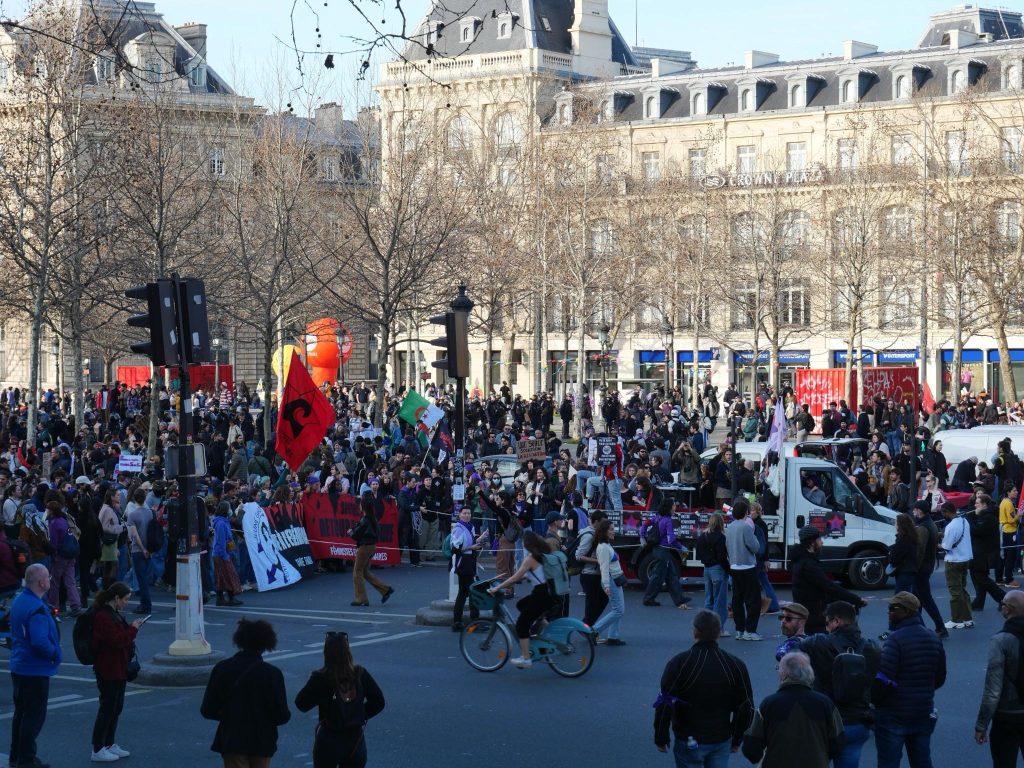
Since we are internationalists, we are always present at international solidarity events, and we show our support publicly in reaction to international current events on social media, whether or not they are specifically feminist. We show up exactly for this reason: to demonstrate the intersectionality between our struggle and those of oppressed peoples of the world.
Building concrete ties to international organizations abroad is very important, but it’s often proven difficult: it’s demanding work, and it’s difficult to sustain in the long-term. We try to do our best, but it’s not our strongest point. It’s something we’re working on, and something we hope to consolidate in the coming period, particularly with the international rise of masculinist and reactionary forces.
We know that it’s absolutely necessary in our times to hold with our analysis of patriarchal racist capitalism as the common enemy, across all borders. This enemy has many faces, but only when we attack him from every side, do we have any chance at victory.
But that doesn’t mean that building international feminist solidarity consists of imposing a unique model! It’s about connection based in understanding, exchange, mutual aid, and recognition of the battles we share. This kind of solidarity is constructed by seeking to understand and include different forms of oppression and different political contexts. From this place of curiosity and humility, only then can we justly support struggles for self-determination, share experience and strategy, and most importantly of all, learn from one another.
As we say at each demonstration, “tant qu’il le faudra, féministe et révolutionnaire.” Which translates to: “as long as we must, we’ll be revolutionary feminists.”
* Access to website: https://feministesrevolutionnaires.org
[1] The concept of femonationalism (defined by sociologist Sara R. Farris) describes on one hand the exploitation of feminist themes and the idea of gender equality by the far-right, particularly in anti-Islamic campaigns. On the other hand, it also describes the endorsement of anti-Islam slogans and ideas by some feminists and “femocrats”. It is a contemporary phenomenon that we can see in countries like France, Italy or the Netherlands, but also across the Western world.